
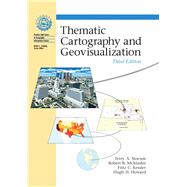
Thematic Cartography and Geovisualization
by Slocum, Terry A.; McMaster, Robert B; Kessler, Fritz C; Howard, Hugh HEdition: 3rd
Format: Hardcover
Pub. Date: 2008-04-04
Publisher(s): Pearson
 Other versions by this Author
-

Free Shipping On Orders Over $59
Free standard shipping on order over $59 to your home address. Marketplace purchases through third-party sellers are excluded from free shipping promotions.

List Price: $239.16
Buy Used
In Stock Usually Ships in 24-48 Hours
$169.98
Rent Textbook
Select for Price
New Textbook
We're Sorry
Sold Out
eTextbook
We're Sorry
Not Available
How Marketplace Works:
- This item is offered by an independent seller and not shipped from our warehouse
- Item details like edition and cover design may differ from our description; see seller's comments before ordering.
- Sellers much confirm and ship within two business days; otherwise, the order will be cancelled and refunded.
- Marketplace purchases cannot be returned to eCampus.com. Contact the seller directly for inquiries; if no response within two days, contact customer service.
- Additional shipping costs apply to Marketplace purchases. Review shipping costs at checkout.
Summary
This comprehensive volume blends broad coverage of basic methods for symbolizing spatial data with an introduction to cutting-edge data visualization techniques.Offers clear descriptions of various aspects of effective, efficient map design, with an emphasis on the practical application of design theories and appropriate use of map elements. Clearly contrasts different approaches for symbolizing spatial data, in addition to individual mapping techniques. This edition includes updated material on the history of thematic cartography, maps and society, scale and generalization, and cartograms and flow mapping.For those interested in learning more about cartography.
Author Biography
Terry A. Slocum currently is an Associate Professor in the Department of Geography at the University of Kansas. He received his B.A. and M.A. from SUNY at Albany, and his Ph.D. from the University of Kansas. Professor Slocum has published extensively in numerous refereed outlets, including Cartography and Geographic Information Science, Cartographica, Journal of Geography, Annals of the Association of American Geographers, The Professional Geographer, and The British Cartographic Journal. He has authored the books Thematic Cartography and Visualization (Prentice-Hall, 1999) and Thematic Cartography and Geographic Visualization (Pearson Education, Inc., 2005) . From 1999 to 2002 , he served as editor of Cartography and Geographic Information Science. He has been involved in numerous grants, including two from the National Science Foundation, and has received two Teacher Appreciation awards from the Center for Teaching Excellence (CTE) at the University of Kansas. From 2003 to the present, he has served as Chair of the Department of Geography at the University of Kansas.
Fritz Kessler is currently an Associate Professor at Frostburg State University (FSU) located in Frostburg, MD and has been teaching a variety of geography courses since the fall of 1999. Professor Kessler’s cartographic background has evolved through a variety of cartographic related positions. He began his career in cartography while working in Ohio University’s Cartographic Center as an undergraduate student. After graduating from Ohio University in 1988 with a B.S. in Geography, he worked for the USGS Water Resource Division in Towson, MD as a Cartographic Technician. After receiving his M.S. from Penn State in 1991, he joined Intergraph as a Systems Analyst in Huntsville, AL. Desirous to return to production cartography, he took a position with R. R. Donnelley and Sons as a Cartographer. Although a fascinating experience, he chose to return to pursue his Ph.D. at the University of Kansas, during which time he worked for the Kansas State Geological Survey as a GIS Technician and as a Map Librarian at the T. R. Smith Map Library.
In his ninth year of teaching at FSU, Fritz also holds a joint appointment through Penn State where he teaches and online course on map projections, datums, and coordinate systems in the Master of Geographic Information Systems degree program. Fritz has published in Cartographica, Cartography and Geographic Information Science, and American Congress on Surveying and Mapping’s Bulletin. Fritz is currently the Editor of Cartographic Perspectives, a peer-reviewed journal focusing on a broad array of cartographic topics, has served on the North American Cartographic and Information Society’s Board of Directors, and was the Secretary in the International Cartographic Association’s Working Group on Map Projections.
Fritz Kessler is currently an Associate Professor at Frostburg State University (FSU) located in Frostburg, MD and has been teaching a variety of geography courses since the fall of 1999. Professor Kessler’s cartographic background has evolved through a variety of cartographic related positions. He began his career in cartography while working in Ohio University’s Cartographic Center as an undergraduate student. After graduating from Ohio University in 1988 with a B.S. in Geography, he worked for the USGS Water Resource Division in Towson, MD as a Cartographic Technician. After receiving his M.S. from Penn State in 1991, he joined Intergraph as a Systems Analyst in Huntsville, AL. Desirous to return to production cartography, he took a position with R. R. Donnelley and Sons as a Cartographer. Although a fascinating experience, he chose to return to pursue his Ph.D. at the University of Kansas, during which time he worked for the Kansas State Geological Survey as a GIS Technician and as a Map Librarian at the T. R. Smith Map Library.
In his ninth year of teaching at FSU, Fritz also holds a joint appointment through Penn State where he teaches and online course on map projections, datums, and coordinate systems in the Master of Geographic Information Systems degree program. Fritz has published in Cartographica, Cartography and Geographic Information Science, and American Congress on Surveying and Mapping’s Bulletin. Fritz is currently the Editor of Cartographic Perspectives, a peer-reviewed journal focusing on a broad array of cartographic topics, has served on the North American Cartographic and Information Society’s Board of Directors, and was the Secretary in the International Cartographic Association’s Working Group on Map Projections.
Table of Contents
| Introduction | |
| Principles Of Cartography | |
| History of Thematic Cartography | |
| Statistical and Graphical Foundation | |
| Principles of Symbolization | |
| Data Classification | |
| Scale and Cartographic Generalization | |
| The Earth and its Coordinate System | |
| Elements of Map Projections | |
| Selecting an Appropriate Projection | |
| Principles of Color | |
| Elements of Map Design | |
| Map Production and Dissemination | |
| Mapping Techniques | |
| Choropleth Mapping | |
| Isarithmic Mapping | |
| Symbolizing Topography | |
| Proportional Symbol Mapping | |
| Dot and Dasymetric Mapping | |
| Bivariate and Multivariate Mapping | |
| Additional Techniques | |
| Geographic Visualizaion | |
| Animation | |
| Data Exploration | |
| Electronic Atlases and Miltimedia | |
| Visualizing Data Quality | |
| Virtual and Mixed Environments | |
| Ongoing Developments | |
| Table of Contents provided by Publisher. All Rights Reserved. |
An electronic version of this book is available through VitalSource.
This book is viewable on PC, Mac, iPhone, iPad, iPod Touch, and most smartphones.
By purchasing, you will be able to view this book online, as well as download it, for the chosen number of days.
Digital License
You are licensing a digital product for a set duration. Durations are set forth in the product description, with "Lifetime" typically meaning five (5) years of online access and permanent download to a supported device. All licenses are non-transferable.
More details can be found here.
A downloadable version of this book is available through the eCampus Reader or compatible Adobe readers.
Applications are available on iOS, Android, PC, Mac, and Windows Mobile platforms.
Please view the compatibility matrix prior to purchase.