
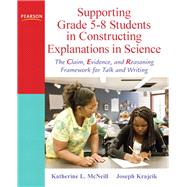
Supporting Grade 5-8 Students in Constructing Explanations in Science The Claim, Evidence, and Reasoning Framework for Talk and Writing
by McNeill, Katherine L.; Krajcik, Joseph S.Edition: 1st
Format: Paperback
Pub. Date: 2011-01-03
Publisher(s): Pearson
 Other versions by this Author
-

Free Shipping On Orders Over $59
Free standard shipping on order over $59 to your home address. Marketplace purchases through third-party sellers are excluded from free shipping promotions.

List Price: $52.96
Buy New
Special Order. We will make every effort to obtain this item but cannot guarantee stock or timing.
$50.44
Rent Book
Select for Price
Used Book
We're Sorry
Sold Out
eBook
We're Sorry
Not Available
How Marketplace Works:
- This item is offered by an independent seller and not shipped from our warehouse
- Item details like edition and cover design may differ from our description; see seller's comments before ordering.
- Sellers much confirm and ship within two business days; otherwise, the order will be cancelled and refunded.
- Marketplace purchases cannot be returned to eCampus.com. Contact the seller directly for inquiries; if no response within two days, contact customer service.
- Additional shipping costs apply to Marketplace purchases. Review shipping costs at checkout.
Summary
By providing a variety of strategies, scenarios, examples of student writing, classroom video clips from across all science content areas, rubrics, and guidelines for designing assessment items,Supporting Grade 5-8 Students in Constructing Explanations in Science: The Claim, Evidence, and Reasoning Framework for Talk and Writing provides teachers with the tools to successfully incorporate scientific explanation in their own classrooms. Grounded in NSF-funded research, this book/DVD supports middle grades science teachers with an instructional framework that breaks down the complex practice of scientific explanation into four components-claim, evidence, reasoning, and rebuttal-and providesconcrete examples of what this scientific inquiry practice looks like when it is successfully implemented in real classrooms. Over the last nine years that McNeill and Krajcik have developed, field tested, and refined this instructional model, they found that incorporating this framework for scientific explanation into curriculum materials, teacher instructional strategies, and assessments enhances students conceptual understanding and improves their ability to think and communicate more scientifically by carefully analyzing evidence and backing up their claims.
Author Biography
Katherine L. McNeill is an Assistant Professor of science education at Boston College. A former middle school science teacher, she received her doctorate in science education from the University of Michigan. Her research focuses on helping students with diverse backgrounds become interested in science and learn both science content and scientific inquiry practices. Specifically, she has recently focused on how to support students in engaging in scientific explanation and argumentation in both talk and writing. Her research has been generously funded by the National Science Foundation (NSF). She has published numerous book chapters and journal articles from this work, including articles in the Journal of Research in Science Teaching, Science Education, The Journal of the Learning Sciences, and International Journal of Science Education.
Joseph Krajcik, a Professor at the University of Michigan, develops classroom environments in which students find solutions to important intellectual questions that subsume essential learning goals. He is a fellow of AAAS and AERA, served as president of National Association for Research in Science Teaching in 1999, and received guest professorships from Beijing Normal University and the Weizmann Institute of Science. In 2009, he was named a distinguished professor at Ewha Woman’s University in South Korea and served as a faculty member in the Institute for Global Science, Technology and Society Education. In 2010, he received the Distinguished Contributions to Science Education Through Research Award from NARST.
Table of Contents
Chapter 1: Importance of Supporting Students in Scientific Explanation
1.1. The role of explanations in science
1.2. Scientific explanations in the classroom
1.3. Benefits of scientific explanations
1.4. Alignment with the national science standards
1.5. Student challenges with scientific explanations
1.6. Check Point
1.7. Study Group Questions
Chapter 2: Framework for Constructing Scientific Explanations
2.1. Students’ understandings of scientific explanations
2.2. Framework for constructing scientific explanations
2.3. Video Example – Introducing the instructional framework
2.4. Examples of scientific explanations
2.5. Increasing the complexity of the framework over time
2.6. Benefits of the framework for all learners
2.7. Check Point
2.8. Study Group Questions
Chapter 3: Designing Learning Tasks for Your Science Curriculum
3.1. Considerations for designing learning tasks
3.2. Step 1: Identify opportunities in the curriculum
3.3. Examples of learning tasks
3.4. Step 2: Design complexity of the learning task
3.5. Step 3: Create Classroom Support
3.6. Check Point
3.7. Study Group Questions
Chapter 4: Teaching Strategies to Integrate into Classroom Instruction
4.1. Teaching strategies
4.2. Supporting all learners
4.3. Check Point
4.4. Study Group Questions
Chapter 5: Developing Assessment Tasks and Rubrics
5.1. Overview of the development process
5.2. Step 1: Identify and unpack the content standard
5.3. Step 2: Select scientific explanation level of complexity
5.4. Step 3: Create learning performances
5.5. Step 4: Write the assessment task
5.6. Step 5: Review the assessment task
5.7. Step 6: Develop specific rubric
5.8. Check Point
5.9. Study Group Questions
Chapter 6: Using Rubrics and Student Data to Inform Instruction
6.1. Role of assessment in creating a supportive learning environment
6.2. Using rubrics to support student learning
6.3. Providing students with feedback
6.4. Check Point
6.5. Study Group Questions
Chapter 7: Supporting Learning Over Time
7.1. Developing a classroom culture
7.2. A learning progression for scientific explanation
7.3. Connecting to other content areas
7.4. Check Point
7.5. Study Group Questions
An electronic version of this book is available through VitalSource.
This book is viewable on PC, Mac, iPhone, iPad, iPod Touch, and most smartphones.
By purchasing, you will be able to view this book online, as well as download it, for the chosen number of days.
Digital License
You are licensing a digital product for a set duration. Durations are set forth in the product description, with "Lifetime" typically meaning five (5) years of online access and permanent download to a supported device. All licenses are non-transferable.
More details can be found here.
A downloadable version of this book is available through the eCampus Reader or compatible Adobe readers.
Applications are available on iOS, Android, PC, Mac, and Windows Mobile platforms.
Please view the compatibility matrix prior to purchase.