
 Other versions by this Author

The ancient topic of universals was central to scholastic philosophy, which raised the question of whether universals exist as Platonic forms, as instantiated Aristotelian forms, as concepts abstracted from singular things, or as words that have universal signification. It might be thought that this question lost its importance after the decline of scholasticism in the modern period. However, the fourteen contributions contained in The Problem of Univerals in Early Modern Philosophy indicate that the issue of universals retained its vitality in modern philosophy. Modern philosophers in fact were interested in 3 sets of issues concerning universals: (i) issues concerning the ontological status of universals, (ii) issues concerning the psychology of the formation of universal concepts or terms, and (iii) issues concerning the value and use of universal concepts or terms in the acquisition of knowledge. Chapters in this volume consider the various forms of "Platonism," "conceptualism" and "nominalism" (and distinctive combinations thereof) that emerged from the consideration of such issues in the work of modern philosophers. Furthermore, this volume covers not only the canonical modern figures, namely, Descartes, Spinoza, Leibniz, Locke, Berkeley, Hume and Kant, but also more neglected figures such as Pierre Gassendi, Pierre-Sylvain Regis, Nicolas Malebranche, Henry More, Ralph Cudworth and John Norris.
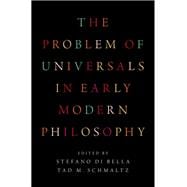
The Problem of Universals in Early Modern Philosophy
by Di Bella, Stefano; Schmaltz, Tad M.Format: Hardcover
Pub. Date: 2017-07-28
Publisher(s): Oxford University Press
-

Free Shipping On Orders Over $59
Free standard shipping on order over $59 to your home address. Marketplace purchases through third-party sellers are excluded from free shipping promotions.
List Price: $203.42
Buy New
Usually Ships in 5-7 Business Days
$193.73
Rent Textbook
Select for Price
Digital
$104.39*
Used Textbook
We're Sorry
Sold Out
How Marketplace Works:
- This item is offered by an independent seller and not shipped from our warehouse
- Item details like edition and cover design may differ from our description; see seller's comments before ordering.
- Sellers much confirm and ship within two business days; otherwise, the order will be cancelled and refunded.
- Marketplace purchases cannot be returned to eCampus.com. Contact the seller directly for inquiries; if no response within two days, contact customer service.
- Additional shipping costs apply to Marketplace purchases. Review shipping costs at checkout.
Summary
Author Biography
Stephano Di Bella is Professor of The History of Philosophy at the University of Milan. Tad Schmaltz is Professor of Philosophy at the University of Michigan.
Table of Contents
1. Introduction to Universals in Modern Philosophy Stefano Di Bella and Tad M. Schmaltz
2. Gassendi on the Problem of Universals Antonia LoLordo
3. Hobbes, Universal Names, and Nominalism Stewart Duncan
4. Spinoza on Universals Samuel Newlands
5. Descartes on Universal Essences and Divine Knowledge Lawrence Nolan
6. Platonism and Conceptualism among the Cartesians Tad M. Schmaltz
7. Universals and Individuals in Malebranche's Philosophy Mariangela Priarolo
8. Universals in English Platonism: More, Cudworth, Norris Brunello Lotti
9. Some Perspectives on Leibniz's Nominalism and Its Sources Stefano Di Bella
10. Locke's Essay and Leibniz's Nouveaux Essais: Competing Theories of Universals Martha Brandt Bolton
11. Locke on General Ideas E. J. Lowe
12. Berkeley on Abstraction, Universals and Universal Knowledge Tom Stoneham
13. Hume on Abstraction and Identity Donald L. M. Baxter
14. Kant on Abstractionism about Concept Formation Alberto Vanzo
An electronic version of this book is available through VitalSource.
This book is viewable on PC, Mac, iPhone, iPad, iPod Touch, and most smartphones.
By purchasing, you will be able to view this book online, as well as download it, for the chosen number of days.
Digital License
You are licensing a digital product for a set duration. Durations are set forth in the product description, with "Lifetime" typically meaning five (5) years of online access and permanent download to a supported device. All licenses are non-transferable.
More details can be found here.
A downloadable version of this book is available through the eCampus Reader or compatible Adobe readers.
Applications are available on iOS, Android, PC, Mac, and Windows Mobile platforms.
Please view the compatibility matrix prior to purchase.