
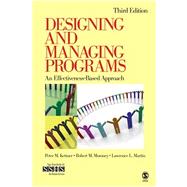
Designing and Managing Programs : An Effectiveness-Based Approach
by Peter M. KettnerEdition: 3rd
Format: Hardcover
Pub. Date: 2007-11-14
Publisher(s): SAGE Publications, Inc
 Other versions by this Author
-

Free Shipping On Orders Over $59
Free standard shipping on order over $59 to your home address. Marketplace purchases through third-party sellers are excluded from free shipping promotions.

List Price: $134.55
Rent Textbook
Select for Price
New Textbook
We're Sorry
Sold Out
Used Textbook
We're Sorry
Sold Out
eTextbook
We're Sorry
Not Available
How Marketplace Works:
- This item is offered by an independent seller and not shipped from our warehouse
- Item details like edition and cover design may differ from our description; see seller's comments before ordering.
- Sellers much confirm and ship within two business days; otherwise, the order will be cancelled and refunded.
- Marketplace purchases cannot be returned to eCampus.com. Contact the seller directly for inquiries; if no response within two days, contact customer service.
- Additional shipping costs apply to Marketplace purchases. Review shipping costs at checkout.
Summary
Designing and Managing Programs: An Effectiveness-Based Approach, Third Edition , is an updated version of THE classic book on program management and design. This new edition is written in a deliberate manner that has students following the program planning process in a logical manner. Students will learn to track one phase to the next, resulting in a solid understanding of the issues of internal consistency and planning integrity. The book's format guides students from problem analysis through evaluation, enabling students to apply these concepts to their own program plans. New to this Edition Includes a chapter on theory : Students will be given clear guidance on applying theory in their approach to planning and understanding the social problem. Uses a consistent example throughout the text : Theoretical concepts are applied consistently to one example throughout the book for easier comprehension. Brings the technology discussion up-to-date : Data collection, processing, aggregating, and reporting practices are updated so they are consistent with current technology as used in most states, communities, and social services agencies. Accompanied by High-Quality Ancillaries! Instructor's Resource CD: An instructor's guide provides suggested assignments and power point presentations. Intended Audience This is an excellent core textbook for advanced undergraduate and graduate course such as Program Planning, Grant Writing, and Program Evaluation in the departments of social work, public administration, and business administration. It is also a valuable resource for social work practitioners.
Table of Contents
| Preface | |
| Assessing Current Practices | |
| Contemporary Issues in Social Service Program Planning and Administration | |
| Chapter Overview | |
| The Era of Accountability | |
| The Logic Model | |
| Community Focus | |
| The Issue of Effectiveness | |
| Assessing an Existing Program | |
| What Is Effectiveness-Based Program Planning? | |
| Using Effectiveness Principles to Understand Existing Programs | |
| Problem Analysis/Needs Assessment | |
| The Contribution of Theory to Program Planning | |
| Chapter Overview | |
| The Use of Theory in Program Planning | |
| Theory of Practice | |
| Theory in Practice | |
| Theory of Program Planning | |
| Types of Planning | |
| Theory in Program Planning | |
| Understanding Social Problems | |
| Chapter Overview | |
| Addressing Social Problems | |
| Stating Problems as Solutions | |
| The Need for a New Approach | |
| Identifying a Social Condition | |
| Defining Problems | |
| Frameworks for Problem Analysis | |
| Needs Assessment: Theoretical Considerations | |
| Chapter Overview | |
| The Concept of Need | |
| Theoretical Understandings of Need | |
| Needs Assessment and the Planning Process | |
| Factors Influencing the Definition of Need | |
| Different Perspectives on Need | |
| Need Categories and the Planning Process | |
| Determining Who Is in Need | |
| Two Major Problems: Reliability and Availability of Data | |
| Needs Assessment: Approaches to Measurement | |
| Chapter Overview | |
| Methodologies Used in Measuring Need | |
| Extrapolating From Existing Studies (Normative Need) | |
| Using Resource Inventories (Normative Need) | |
| Using Service Statistics (Expressed Need) | |
| Conducting a Social Survey (Perceived Need) | |
| Holding a Public Forum (Perceived Need) | |
| Selecting the Best Method | |
| Approaches Useful for Locating Concentrations of High-Risk Groups | |
| Concluding Comments on Needs Assessment | |
| Planning, Designing, and Tracking The Intervention | |
| Selecting the Appropriate Intervention Strategy | |
| Chapter Overview | |
| The Program Hypothesis | |
| Types of Program Hypotheses | |
| The Process of Developing a Program Hypothesis | |
| Program Hypotheses and the Idea of Consequences | |
| From Program Hypothesis to Service | |
| Incorporating Problem Analysis Into Program Design | |
| Setting Goals and Objectives | |
| Chapter Overview | |
| Goals and Objectives: A Framework for Action | |
| From Program Hypothesis to Goals and Objectives | |
| The Function of a Mission Statement | |
| The Formulation of Goals | |
| The Formulation of Objectives | |
| Requirements for All Objectives | |
| Outcome Objectives | |
| Process Objectives and Activities | |
| Integrating Outcome Objectives, Process Objectives, and Activities | |
| Designing Effective Programs | |
| Chapter Overview | |
| The Significance of Program Design | |
| Designing the Elements of a System | |
| Defining the Elements of a Program | |
| The Relationship Between Objectives and System Components | |
| Specifying the Program Hypothesis | |
| Using Management Information | |
| Chapter Overview | |
| Documentation Practices in Social Services | |
| Designing a Data Collection System for a Program | |
| Calculating The Costs and Value of The Intervention | |
| Budgeting for Control, Management, and Planning | |
| Chapter Overview | |
| The Differences Between Budgeting and Accounting | |
| The Principal Purposes of Budgeting | |
| Budgeting and the Systems Framework | |
| Models of the Budgetary Process | |
| Major Budgeting Systems | |
| Dealing With Revenue Increases and Decreases | |
| Budgeting in Social Service Agencies Today | |
| Line-Item, Functional, and Program Budgeting Systems | |
| Chapter Overview | |
| The Focus of Major Budgeting Systems | |
| Line-Item Budgeting Systems | |
| The Link Between Line-Item Budgeting and Functional and Program Budgeting | |
| Functional Budgeting Systems | |
| Program Budgeting Systems | |
| A Comprehensive Budgeting System | |
| Performance Measurement, Monitoring, and Program Evaluation: Data Requirements | |
| Chapter Overview | |
| The Link Between Performance Measurement, Monitoring and Evaluation, and Management Information Systems | |
| Feedback and Self-Evaluating Systems | |
| Performance Measurement | |
| Monitoring | |
| Program Evaluation | |
| Program Data Requirements | |
| Performance Measurement, Monitoring, Program Evaluation, and Program Data | |
| The Utility of Performance Measurement, Monitoring, and Program Evaluation | |
| Program Impact Evaluation and Hypothesis Testing | |
| Chapter Overview | |
| Differentiating Program Evaluation From Performance Measurement | |
| Impact Program Evaluation | |
| Impact Program Evaluation and Hypothesis Testing | |
| Research Designs for Impact Program Evaluation | |
| A Concluding Comment | |
| About the Authors | |
| Table of Contents provided by Ingram. All Rights Reserved. |
An electronic version of this book is available through VitalSource.
This book is viewable on PC, Mac, iPhone, iPad, iPod Touch, and most smartphones.
By purchasing, you will be able to view this book online, as well as download it, for the chosen number of days.
Digital License
You are licensing a digital product for a set duration. Durations are set forth in the product description, with "Lifetime" typically meaning five (5) years of online access and permanent download to a supported device. All licenses are non-transferable.
More details can be found here.
A downloadable version of this book is available through the eCampus Reader or compatible Adobe readers.
Applications are available on iOS, Android, PC, Mac, and Windows Mobile platforms.
Please view the compatibility matrix prior to purchase.