
 Other versions by this Author
-

Free Shipping On Orders Over $59
Free standard shipping on order over $59 to your home address. Marketplace purchases through third-party sellers are excluded from free shipping promotions.

List Price: $132.44
Buy New
Usually Ships in 5-7 Business Days
$126.13
Rent Textbook
Select for Price
Digital
$41.58*
Used Textbook
We're Sorry
Sold Out
How Marketplace Works:
- This item is offered by an independent seller and not shipped from our warehouse
- Item details like edition and cover design may differ from our description; see seller's comments before ordering.
- Sellers much confirm and ship within two business days; otherwise, the order will be cancelled and refunded.
- Marketplace purchases cannot be returned to eCampus.com. Contact the seller directly for inquiries; if no response within two days, contact customer service.
- Additional shipping costs apply to Marketplace purchases. Review shipping costs at checkout.
Summary
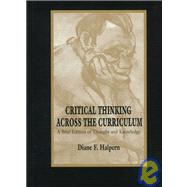
This book, an abridged version of the author's best-selling text, Thought & Knowledge, will be useful as a companion in any course where critical thinking is emphasized or valued, or as a brief introduction to research and practice on critical thinking.<
Table of Contents
| Preface | vii | ||||
|
1 | (17) | |||
|
18 | (28) | |||
|
46 | (34) | |||
|
80 | (18) | |||
|
98 | (42) | |||
|
140 | (20) | |||
|
160 | (28) | |||
|
188 | (30) | |||
|
218 | (24) | |||
|
242 | (19) | |||
|
261 | (1) | |||
| References | 262 | (9) | |||
| Author Index | 271 | (5) | |||
| Subject Index | 276 |
An electronic version of this book is available through VitalSource.
This book is viewable on PC, Mac, iPhone, iPad, iPod Touch, and most smartphones.
By purchasing, you will be able to view this book online, as well as download it, for the chosen number of days.
Digital License
You are licensing a digital product for a set duration. Durations are set forth in the product description, with "Lifetime" typically meaning five (5) years of online access and permanent download to a supported device. All licenses are non-transferable.
More details can be found here.
A downloadable version of this book is available through the eCampus Reader or compatible Adobe readers.
Applications are available on iOS, Android, PC, Mac, and Windows Mobile platforms.
Please view the compatibility matrix prior to purchase.